
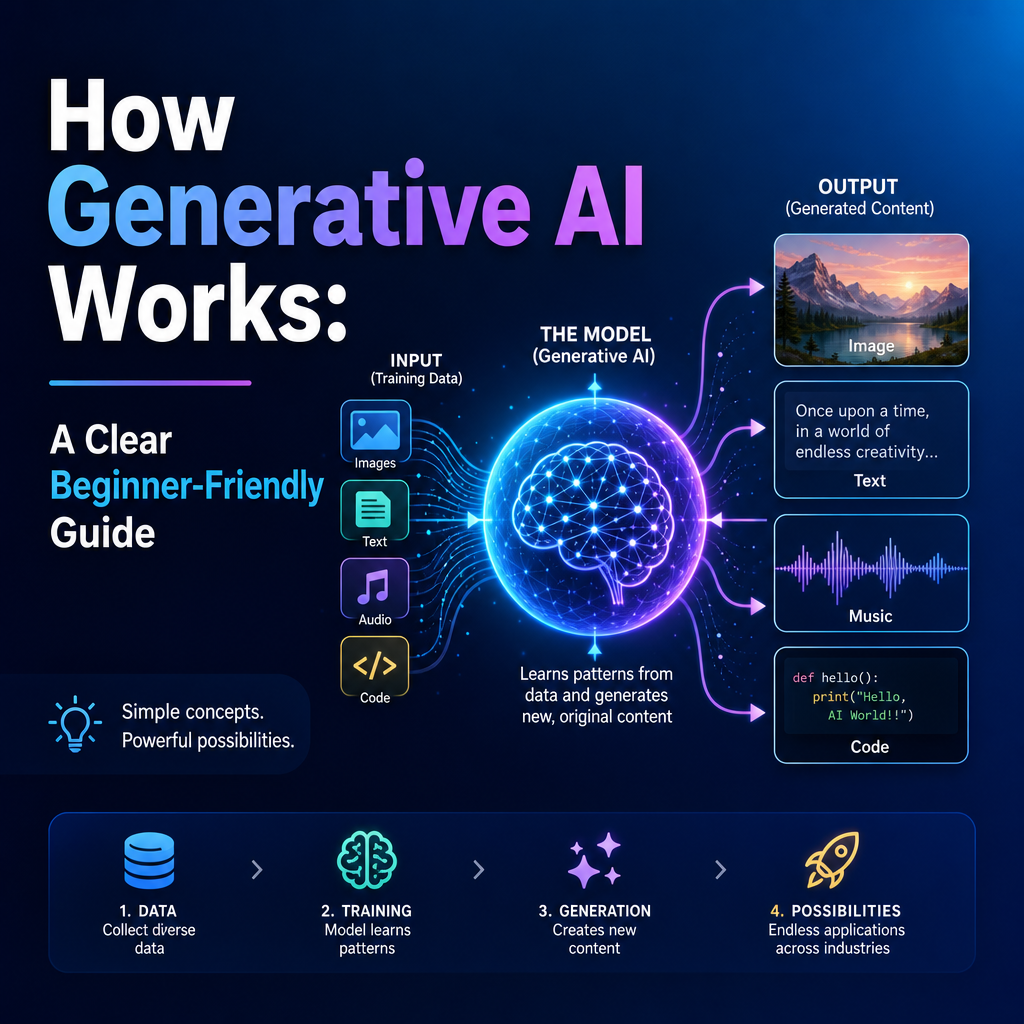
How Generative AI Works: A Clear Beginner-Friendly Guide
Generative AI has moved from a niche research topic to a mainstream technology used in writing tools, image apps, coding assistants, and customer service platforms. But for many people, it still feels mysterious. What exactly is happening behind the scenes when a tool creates text, images, music, or video from a simple prompt?
At a basic level, generative AI is a type of artificial intelligence designed to create new content. Instead of only classifying, sorting, or predicting existing data, it generates something new that resembles the patterns it learned during training.
Understanding how generative AI works does not require advanced math. It helps to think of it as a system that studies huge amounts of examples, learns patterns from them, and then uses those patterns to produce original outputs.
What Is Generative AI?
Generative AI refers to models that can produce content such as:
- Articles and emails
- Images and illustrations
- Code
- Audio and music
- Video
- Product descriptions and summaries
These systems do not “think” like humans. They identify patterns in data and use probabilities to decide what should come next in a sequence, whether that sequence is a sentence, a melody, or a collection of pixels.
The Core Idea Behind How Generative AI Works
The simplest way to understand how generative AI works is to break it into three stages:
1. Training on Large Datasets
Generative AI models are trained on massive amounts of data. For a text model, that might include books, websites, articles, and other written material. For an image model, it may include millions of labeled images.
During training, the model analyzes patterns, structure, style, and relationships within the data. For example, a language model learns that certain words commonly appear together, that grammar follows patterns, and that context affects meaning.
It does not memorize everything in a simple copy-and-paste way. Instead, it builds a mathematical representation of patterns across the data.
2. Learning Patterns and Relationships
Once training begins, the model adjusts internal parameters to improve its ability to predict outcomes. In text generation, a model often learns by trying to guess the next word in a sentence. If it guesses incorrectly, it updates itself and tries millions or billions of times again.
Over time, it becomes better at understanding:
- Sentence structure
- Context and tone
- Common facts and associations
- Stylistic patterns
- Logical sequences
This is the foundation of how generative AI works: repeated pattern learning at a very large scale.
3. Generating New Content From Prompts
After training, the model can respond to a user prompt. If someone asks for a blog introduction, a poem, or a product image, the AI uses what it learned to generate a response step by step.
For text, it predicts one token at a time. A token may be a word, part of a word, or punctuation. Each new token is chosen based on probability and context. This process happens extremely fast, which is why the response appears almost instantly.
How Different Types of Generative AI Work
Not all generative AI systems create the same kind of output. The underlying methods can differ depending on the task.
Text Generation Models
Text generators, such as large language models, are trained on written content. They produce responses by predicting the most likely continuation of a prompt while balancing coherence, relevance, and style.
These models are used for:
- Chatbots
- Content drafting
- Translation
- Summarization
- Coding assistance
Image Generation Models
Image generators learn from visual datasets. Many modern systems use diffusion techniques, which start with random noise and gradually refine it into an image that matches the prompt.
For example, if a user types “a watercolor painting of a mountain village at sunrise,” the model builds an image by aligning visual patterns with those words.
Audio and Video Models
Audio tools can generate speech, music, or sound effects. Video models go a step further by predicting sequences of images over time. These systems are more complex because they must maintain consistency across movement, timing, and style.
Why Prompts are Important
Prompts shape the final output. Since generative AI responds based on input and learned patterns, clearer instructions usually produce better results.
A strong prompt often includes:
- The desired format
- Tone or style
- Key details
- Constraints or requirements
- Examples, if needed
For instance, asking for “a professional 100-word product description for a luxury skincare brand” will usually produce a more useful result than simply saying “write about skincare.”
Limitations of Generative AI
To fully understand how generative AI works, it is important to know what it cannot do reliably.
It Can Be Wrong
Generative AI can produce confident-sounding but inaccurate information. This happens because it generates items based on patterns rather than a true understanding of original artifacts.
It May Reflect Bias
If training data contains bias, the model can reproduce it in outputs.
It Lacks Real Understanding
Although the results may appear intelligent, the system does not possess human judgment, awareness, or intent.
Output Quality Depends on Data and Design
The model’s performance is heavily shaped by its training data, architecture, and safety controls.
Final Thoughts
Generative AI is changing how people work and create. It can speed up routine tasks, help brainstorm ideas, automate content creation, and make complex tools more accessible. Businesses use it for marketing, support, and productivity. Creators use it for design, writing, and experimentation. Developers use it to build faster and test ideas quickly.
As the technology improves, generative AI will become even more capable and more common in everyday tools. Knowing how it works helps you use it more effectively, ask better questions, and understand both its power and its limitations.