
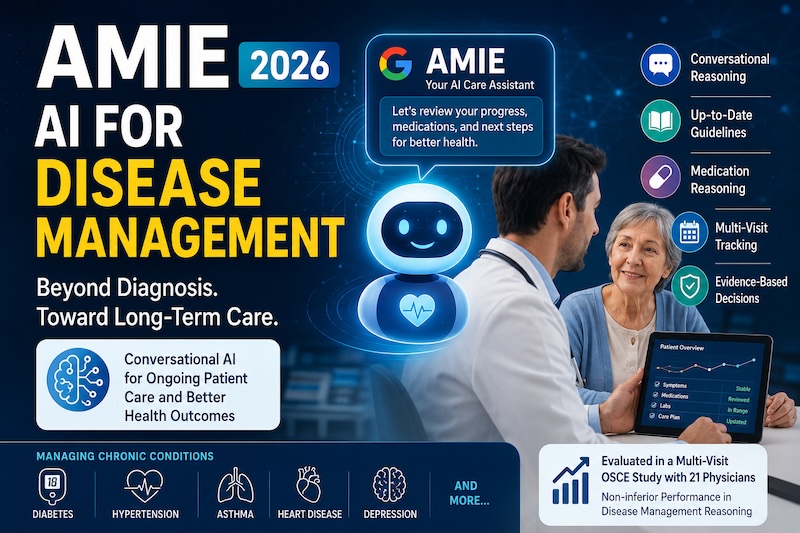
AMIE: How Conversational AI Is Moving Beyond Diagnosis to Disease Management
AI has already demonstrated remarkable capabilities in medical imaging, clinical documentation, and disease diagnosis. However, one of the most challenging aspects of healthcare is not making an initial diagnosis—it is managing a patient’s condition over time. Chronic diseases such as diabetes, hypertension, asthma, heart disease, and depression often require continuous monitoring, medication adjustments, follow-up visits, and adherence to evolving clinical guidelines.
A recent breakthrough from Google DeepMind and Google Research introduces a new version of AMIE (Articulate Medical Intelligence Explorer), an AI system designed not only to assist with diagnosis but also to support long-term disease management. This development represents a significant step toward conversational AI systems that can help clinicians and patients navigate ongoing care. While the technology is not yet ready for independent clinical use, its latest results suggest that AI may soon become an important member of the healthcare team.
AMIE was evaluated in a randomized, blinded virtual clinical examination using simulated patient scenarios and trained patient actors. While the results are promising, the system has not yet been validated through prospective real-world clinical studies.
What Is AMIE?
AMIE is a large language model (LLM)-based medical AI system developed by Google. Earlier versions of AMIE focused primarily on diagnostic conversations, where the system interacted with patients, gathered medical histories, and reasoned through possible diagnoses.
In a landmark study published in Nature in 2025, AMIE demonstrated diagnostic performance comparable to, and in some cases exceeding, that of primary care physicians in simulated text-based consultations.
The newest version of AMIE expands its capabilities from diagnosis to disease management. Rather than focusing on a single clinical encounter, the system is designed to reason across multiple patient visits, track disease progression, evaluate responses to treatment, and make recommendations aligned with established medical guidelines.
Reference:
https://www.nature.com/articles/s41586-025-08866-7
Why Disease Management Matters
Many healthcare challenges emerge after a diagnosis has been made.
Consider a patient with Type 2 diabetes. The diagnosis itself may be straightforward, but managing the disease requires ongoing decisions:
- Should medications be adjusted?
- Are blood glucose levels improving?
- Is the patient experiencing side effects?
- Are lifestyle interventions working?
- Should additional tests be ordered?
Similar challenges exist for hypertension, heart disease, asthma, chronic kidney disease, and many other conditions.
Effective disease management requires clinicians to integrate information collected over time, apply current clinical guidelines, and communicate treatment plans clearly to patients. This process is complex and often constrained by limited appointment times and growing physician workloads.
How the New AMIE (2026) Works
The latest AMIE system (2026) uses an agent-based architecture designed specifically for longitudinal patient care.
The system combines:
- Conversational reasoning with patients
- Access to up-to-date clinical practice guidelines
- Medication reasoning capabilities
- Multi-visit tracking of patient conditions
- Structured clinical decision-making
One of the most important innovations is its ability to ground recommendations in authoritative medical sources. AMIE leverages Gemini’s long-context capabilities to retrieve and reason over clinical guidelines and drug formularies while maintaining awareness of a patient’s evolving medical history.
Instead of simply answering questions, the system attempts to perform the type of management reasoning physicians engage in during follow-up visits.
Reference:
https://www.nature.com/articles/s41586-026-10764-5
The Study
Researchers evaluated AMIE through a randomized, blinded virtual Objective Structured Clinical Examination (OSCE) involving 21 primary care physicians and 100 multi-visit patient scenarios. The cases were designed according to established clinical guidelines, including recommendations from the UK National Institute for Health and Care Excellence (NICE) and BMJ Best Practice. Unlike many AI evaluations that focus on isolated questions, this study simulated ongoing patient care across multiple encounters, providing a more realistic assessment of disease management capabilities.
The evaluation examined how well AMIE performed tasks such as treatment planning, medication management, ordering investigations, following clinical guidelines, and communicating with patients. Overall, AMIE achieved performance that was considered non-inferior to physicians in disease management reasoning. In several areas, including treatment precision and guideline adherence, it received higher scores than participating physicians.
The researchers also introduced RxQA, a benchmark specifically designed to evaluate medication-related reasoning. On more challenging medication-management tasks, AMIE outperformed physicians, particularly in selecting treatments and making complex therapeutic decisions.
Potential Benefits
If systems like AMIE eventually prove safe and effective in real-world settings, they could provide several benefits.
1. Improved Guideline Adherence
Medical knowledge evolves rapidly. Keeping up with changing recommendations is difficult even for experienced clinicians.
An AI system that continuously references current guidelines could help reduce variability in care and ensure recommendations remain evidence-based.
2. Better Chronic Disease Monitoring
Patients with chronic illnesses often require frequent follow-up. AI systems may help identify trends in symptoms, treatment responses, and laboratory results between visits.
3. Enhanced Patient Communication
AMIE was designed to conduct conversational interactions with patients. Such systems could provide educational explanations, answer routine questions, and improve patient engagement.
4. Reduced Administrative Burden
Healthcare professionals spend significant time reviewing records and documenting encounters. AI assistants could summarize patient histories and generate structured care recommendations, allowing physicians to focus more on clinical decision-making.
5. Expanded Access to Care
Many regions face shortages of primary care physicians and specialists. AI-assisted disease management tools could help extend healthcare resources, especially in underserved areas.
Important Limitations
Despite encouraging results, the researchers emphasize that AMIE is not ready for independent clinical deployment.
Several limitations remain:
Simulated Environment
The study used carefully designed patient scenarios rather than real clinical encounters. Real patients often present incomplete information, conflicting symptoms, and unpredictable behaviors.
Safety Concerns
Medical errors can have serious consequences. Even highly capable AI systems occasionally generate incorrect recommendations or reasoning errors.
Human Oversight Is Essential
Researchers continue to emphasize that physician oversight remains critical. The most likely future model is not AI replacing clinicians but AI augmenting clinical workflows.
Regulatory and Ethical Challenges
Questions regarding liability, privacy, informed consent, and regulatory approval must be addressed before widespread adoption.
The Future of Conversational Healthcare AI
The progression of AMIE illustrates a broader trend in healthcare AI.
Early systems focused on classification tasks such as identifying diseases in medical images. More recent systems assist with documentation and summarization. The newest generation aims to participate in clinical reasoning and long-term patient management.
Researchers envision future AI systems acting as collaborative care partners—helping physicians track patient progress, monitor treatment effectiveness, and ensure adherence to evidence-based practices.
While substantial work remains before such systems can be safely integrated into healthcare delivery, AMIE demonstrates that conversational AI is rapidly moving beyond diagnosis and toward comprehensive disease management.
The coming years may determine whether these technologies become trusted assistants that help healthcare professionals deliver more personalized, efficient, and accessible care.
References
- Nature: Towards Conversational AI for Disease Management
https://www.nature.com/articles/s41586-026-10764-5 - Nature: Towards Conversational Diagnostic Artificial Intelligence
https://www.nature.com/articles/s41586-025-08866-7 - Nature Medicine: A Large Language Model for Complex Cardiology Care
https://www.nature.com/articles/s41591-025-04190-9