
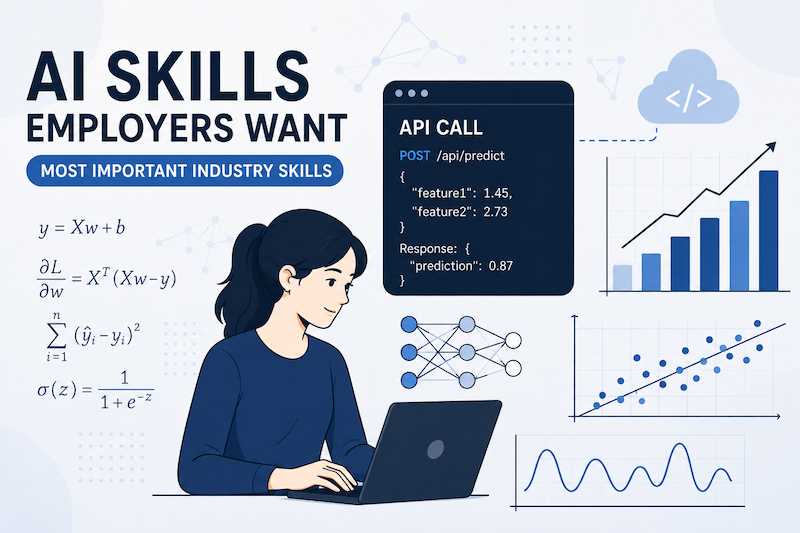
AI Skills Employers Seek: The Most Important Industry Skills
Artificial intelligence is transforming nearly every industry. From healthcare and finance to manufacturing, cybersecurity, logistics, and retail, organizations are investing heavily in AI-driven solutions to improve efficiency, reduce costs, and make better decisions.
At the same time, many discussions about AI have become heavily focused on large language models (LLMs) and tools like ChatGPT. While LLM-driven applications are important, employers increasingly recognize that not every business problem is a language problem. Many real-world AI applications involve forecasting demand, detecting fraud, predicting equipment failures, identifying cybersecurity threats, optimizing supply chains, analyzing sensor data, and supporting medical decisions.
As a result, the AI skills employers value today extend far beyond prompt engineering. Companies are looking for professionals who understand AI fundamentals, can work with data, and know how to apply the right techniques to solve practical business challenges.
Why AI Skills Matter More Than Ever
Organizations are under pressure to become more efficient, data-driven, and competitive. AI offers powerful tools to achieve these goals, but technology alone does not create value. Success depends on people who can understand business needs, evaluate available data, and implement effective solutions.
This is why the most important AI skills combine technical knowledge, analytical thinking, and business understanding. Employers want professionals who can move beyond AI hype and deliver measurable results.
The Most Important AI Skills Companies Are Hiring For
Despite the excitement surrounding generative AI tools, most industry AI applications are not centered on large language models. Companies continue to rely heavily on machine learning and deep learning for tasks such as prediction, classification, anomaly detection, recommendation systems, computer vision, forecasting, and optimization. This is why employers increasingly value candidates with strong AI fundamentals alongside practical experience using modern AI tools.
Of course, professionals who possess expertise in machine learning and deep learning, as well as experience with LLMs, generative AI, and agentic AI systems, are often among the most sought-after candidates in today’s job market. Below are some key competencies employers look for when hiring AI talent.
1. Machine Learning and Deep Learning Fundamentals
One of the biggest misconceptions in today’s market is that AI skills are primarily about using chatbots and generative AI tools. In reality, strong foundations in machine learning and deep learning have become even more valuable as organizations seek to build AI systems tailored to their specific needs.
Many industry applications still rely on traditional machine learning and deep learning models rather than LLMs. Examples include:
- Predictive maintenance in manufacturing
- Medical diagnosis and imaging analysis
- Fraud detection in financial systems
- Cybersecurity threat detection
- Customer churn prediction
- Demand forecasting and inventory management
- Sensor and IoT analytics
Employers increasingly appreciate candidates who understand:
- Supervised and unsupervised learning
- Feature engineering
- Model training and evaluation
- Overfitting and underfitting
- Neural networks and deep learning
- Classification, regression, and clustering
- Model deployment and monitoring
These skills provide a foundation that remains valuable even as AI tools and platforms continue to evolve.
2. Data Literacy
AI systems are only as good as the data they use. Understanding how data is collected, processed, and interpreted is essential across technical and non-technical roles.
Important data literacy skills include:
- Understanding data quality issues
- Identifying bias and inconsistencies
- Interpreting dashboards and reports
- Applying basic statistical reasoning
- Drawing actionable conclusions from data
Employers want professionals who can ask meaningful questions about data rather than simply consume reports.
3. Generative AI and Prompt Engineering
Generative AI has become an important workplace tool. Employees who know how to effectively use AI assistants can often complete tasks faster and improve productivity.
However, employers increasingly view prompting as one skill among many rather than the defining AI skill.
Strong users of generative AI know how to:
- Write clear prompts
- Refine outputs through iteration
- Verify accuracy and reliability
- Integrate AI into existing workflows
- Use AI responsibly without overreliance
The most effective professionals understand both what generative AI can do and where its limitations exist.
4. Programming and Automation
Many AI-related positions still require coding skills. Even employees in less technical roles benefit from understanding how automation can improve efficiency.
Valuable technical skills include:
- Python programming
- SQL and database querying
- API integration
- Workflow automation
- Data processing pipelines
- Cloud-based AI tools and platforms
Organizations increasingly seek individuals who can automate repetitive tasks and connect AI capabilities with business processes.
5. Model Evaluation and Critical Thinking
Building a model is only part of the job. Understanding whether it works reliably is equally important.
Employers value professionals who can:
- Evaluate model performance
- Interpret results correctly
- Identify weaknesses and risks
- Recognize data limitations
- Detect potential bias and errors
As AI adoption grows, critical thinking becomes a major differentiator between professionals who simply use AI tools and those who can apply them effectively.
6. Model Improvement and Fine-Tuning
Building a model is only the beginning. In real-world environments, AI systems often require continuous refinement to improve performance, adapt to changing conditions, and address newly discovered weaknesses.
Employers value professionals who can:
- Analyze model evaluation results
- Fine-tune model parameters and architectures
- Improve feature selection and data quality
- Address performance bottlenecks
- Retrain models with new data
- Balance accuracy, efficiency, and business requirements
Whether working with traditional machine learning models, deep learning systems, or large language models, the ability to iteratively improve a model based on evidence and feedback is highly valued. Organizations want professionals who can move beyond simply building models and help ensure those models continue to deliver value over time.
Soft Skills and Ethics Remain Essential
Communication
AI solutions create value only when people understand them. Professionals must be able to explain technical concepts to managers, customers, and stakeholders.
Strong communication skills include:
- Presenting findings clearly
- Explaining technical results in business terms
- Communicating risks and trade-offs
- Recommending actionable next steps
Problem-Solving
Companies do not invest in AI because it is fashionable. They invest in AI to solve real business problems.
Successful professionals can:
- Identify opportunities for AI adoption
- Select appropriate techniques
- Understand when AI is expensive or unnecessary
- Focus on measurable outcomes
Adaptability
The AI landscape changes rapidly. New models, tools, and platforms emerge constantly.
Employers value individuals who are willing to learn continuously and adapt to changing technologies while maintaining strong foundational knowledge.
AI Ethics and Responsible Use
As AI becomes more integrated into business operations, ethical considerations are becoming increasingly important. Organizations remain responsible for the decisions they make, even when AI systems are involved. Employers cannot use AI as an excuse for malpractice, discrimination, privacy violations, regulatory non-compliance, or other harmful outcomes. Human oversight, accountability, and responsible decision-making remain essential, regardless of how advanced the technology becomes.
Organizations are paying greater attention to:
- Data privacy
- Transparency
- Fairness and bias
- Regulatory compliance
- Security and risk management
Professionals who understand responsible AI practices can help organizations build systems that are both effective and trustworthy.
This is especially important in industries such as healthcare, finance, education, cybersecurity, and human resources.
How to Build the AI Skills Employers Seek
Developing in-demand AI skills requires more than learning the latest tools or mastering prompt engineering. The following recommendations focus on building strong fundamentals in machine learning and deep learning, gaining practical experience, and understanding how AI creates value in real-world settings.
Build Strong AI Fundamentals
Start by developing a solid foundation in machine learning, deep learning, statistics, and data analysis. While AI tools and platforms change rapidly, the underlying principles remain highly valuable. Understanding how models learn, how they are evaluated, and where they can fail will help you adapt to new technologies throughout your career.
Gain Hands-On Experience
Theory is important, but employers place significant value on practical experience. Work with real datasets, build models, analyze results, and solve realistic problems. Hands-on experience helps you develop intuition that cannot be gained from courses alone.
Learn Modern AI Tools and LLMs
Generative AI, large language models, and AI assistants are becoming common workplace tools. Learn how to use them effectively, but do not focus exclusively on prompting. The strongest candidates combine LLM expertise with a broader understanding of machine learning, deep learning, automation, and data-driven problem-solving.
Build Real-World Projects
Projects demonstrate that you can apply your knowledge to practical challenges. Consider building:
- Predictive analytics applications
- Classification and anomaly detection systems
- Recommendation engines
- Computer vision solutions
- Automation workflows
- AI-powered business applications
Well-designed projects showcase both your technical abilities and your problem-solving skills.
Learn to Evaluate and Improve Models
Training a model is only one step in the AI lifecycle. Employers highly value professionals who can evaluate performance, identify weaknesses, and continuously improve models.
Develop experience with:
- Model evaluation and validation
- Error analysis
- Fine-tuning and optimization
- Feature engineering
- Retraining with new data
- Performance monitoring after deployment
The ability to iteratively improve AI systems is often what separates successful AI practitioners from beginners.
Understand Business Context
Successful AI professionals understand how organizations operate and where AI can create measurable value. Learn how AI is applied in areas such as operations, healthcare, finance, marketing, customer service, manufacturing, education, and cybersecurity.
The goal is not simply to build models, but to solve meaningful business problems.
Practice Ethical and Responsible AI
As AI becomes more widely adopted, employers increasingly expect professionals to understand the ethical responsibilities that come with developing and deploying AI systems. Organizations remain accountable for the outcomes of the systems they use, and AI cannot be used as an excuse for malpractice, discrimination, privacy violations, or regulatory failures.
Develop an understanding of:
- Bias and fairness in AI systems
- Data privacy and security
- Transparency and explainability
- Responsible use of generative AI
- Regulatory and compliance considerations
- Human oversight and accountability
Professionals who combine technical expertise with ethical awareness are better equipped to build AI systems that are both effective and trustworthy.
Final Thoughts
The AI job market is evolving rapidly, but one trend is becoming increasingly clear: strong fundamentals matter.
While generative AI and LLMs have attracted enormous attention, many of the most valuable industry applications still rely on machine learning, deep learning, data analysis, and predictive modeling. Employers are looking for professionals who understand these foundations and can apply them to real-world challenges.
In the years ahead, the strongest candidates will not simply know how to use AI tools. They will understand how AI works, when to use it, and how to create meaningful value from it. The most important AI skills today include machine learning fundamentals, data literacy, programming, automation, problem-solving, communication, and responsible AI practices. Professionals who combine these capabilities with practical experience will be well-positioned for long-term success.