
Open Source vs. Closed AI Models: Which Approach Will Shape the Future?
Artificial intelligence is rapidly moving from research labs into everyday products, business operations, healthcare, education, and government services. As AI adoption grows, one question continues to spark debate:
Should AI models be open or closed?
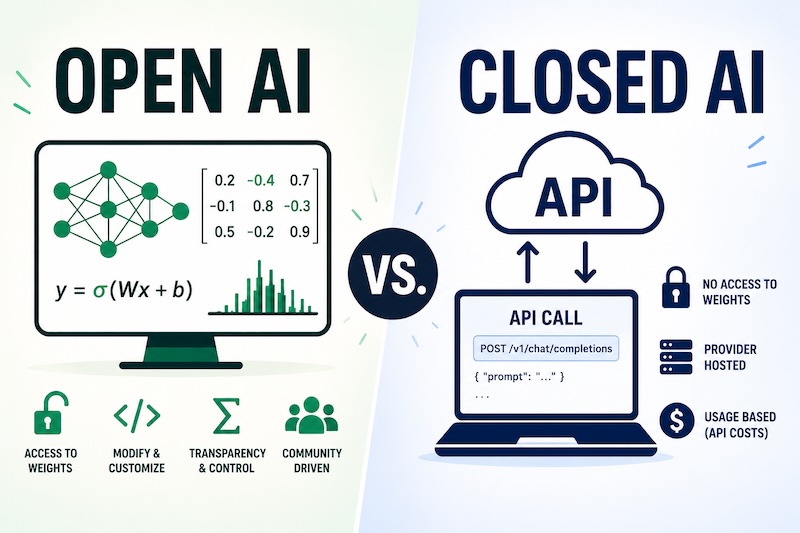
At first glance, the distinction seems straightforward. Open models make key components available to developers and researchers, while closed models keep those components private and under the control of the company that built them.
In reality, the discussion is much broader. It touches on innovation, transparency, security, costs, competition, and even who gets to influence the future direction of AI.
What Are Open AI Models?
Open AI models are systems that make some or all of their components available for others to use, inspect, modify, or build upon.
However, “open” can mean different things depending on the model and its license. Some models provide:
- Open model weights
- Open training code
- Open research papers and architectures
- Open datasets (less common)
- Permissions for commercial use
For example, Mistral AI has released several highly capable open-weight models, and DeepSeek has gained attention by releasing powerful models that organizations can run themselves. Meta’s Llama family is another well-known example. While these models are often described as open source, many experts prefer the term open-weight because the model weights are available, but not all of the training data, code, and development details are publicly released.
Regardless of the terminology, these models give developers significantly more flexibility than traditional proprietary systems.
Why AI Researchers and Developers Like Open Models
Open models appeal to startups, researchers, and technical teams for several reasons.
Customization
Organizations can fine-tune models for specialized domains such as medicine, law, cybersecurity, finance, or education.
Greater Control
Teams can run models on their own infrastructure rather than relying entirely on an external provider.
Lower Vendor Dependence
If a company builds critical workflows around an API, pricing changes or policy changes can create challenges. Open models provide an alternative path.
Community Innovation
Thousands of developers and researchers can contribute improvements, identify bugs, publish optimizations, and create specialized versions. This collaborative ecosystem has helped open models improve at an impressive pace over the last few years.
What Are Closed AI Models?
Closed AI models are developed and maintained by companies that restrict access to the model’s internal components. Users typically interact with these systems through APIs, applications, or enterprise platforms.
Examples include OpenAI’s most of the GPT models, Anthropic’s Claude models, and Google’s Gemini models. These systems provide powerful AI capabilities through APIs and applications, but users generally do not have access to the underlying model weights, training data, or full technical details. For many organizations, that tradeoff is perfectly acceptable because they are primarily interested in outcomes rather than model internals.
Why Businesses Often Choose Closed Models
Many organizations prioritize convenience and reliability over customization.
Managed Infrastructure
There is no need to maintain GPUs, deployment pipelines, or model updates.
Strong Performance
Companies such as OpenAI and Anthropic invest enormous resources into training and optimizing their models.
Enterprise Support
Businesses often receive service-level agreements, security controls, compliance features, and dedicated support.
Faster Adoption
Developers can integrate powerful AI capabilities through an API without building an AI infrastructure from scratch.
For teams that want to move quickly, closed models can significantly reduce complexity.
Open Source vs. Closed AI Models: A Side-by-Side Comparison
The following table provides a side-by-side comparison of open- and closed-source AI models.
| Feature | Open Models | Closed Models |
|---|---|---|
| Transparency | Higher visibility into model behavior and design | Limited visibility |
| Customization | Extensive fine-tuning and modification | Usually restricted. Fine-tuning can be expensive. |
| Deployment | Can be hosted privately | Typically vendor-hosted |
| Initial Setup | More technical effort | Faster to deploy |
| Ongoing Costs | Infrastructure and maintenance costs | API and subscription costs |
| Vendor Lock-In | Lower | Higher |
| Community Contributions | Strong ecosystem involvement | Controlled by the provider |
| Enterprise Support | Varies by provider | Usually stronger |
| Data Control | Greater local control | Depends on vendor policies |
| Ease of Use | Moderate to difficult | Generally easier |
Transparency and Trust
One of the strongest arguments for open models is transparency.
Researchers can inspect how the model behaves, evaluate potential biases, and test for vulnerabilities. Organizations can better understand the systems they are deploying.
Closed models, by contrast, often operate as black boxes. Users can observe inputs and outputs, but may have limited visibility into how decisions are made.
That does not automatically make closed models less trustworthy, but it can make independent auditing more difficult.
Security and Privacy
Security discussions often produce arguments on both sides.
Supporters of open models point out that organizations can deploy them entirely within private environments. This is particularly attractive for healthcare, government, defense, and other sectors with strict data requirements.
Supporters of closed models argue that centralized control allows providers to quickly patch vulnerabilities, implement safety measures, and monitor misuse.
In practice, security depends as much on how a model is deployed and governed as it does on whether the model is open or closed.
The Safety Debate
Perhaps the most controversial issue in the open source vs. closed AI models debate is safety.
Advocates of closed models argue that restricting access helps reduce misuse. If powerful capabilities are freely available, they could potentially be used for spam campaigns, cyberattacks, disinformation, or other harmful activities.
Advocates of open models counter that transparency can improve safety. When more researchers have access, more people can identify biases, vulnerabilities, and unexpected behaviors.
The software industry has faced a similar debate for decades. Open-source software powers much of the internet today, yet proprietary software remains dominant in many commercial environments.
AI may ultimately follow a similar path, where both approaches coexist and serve different needs.
Which Approach Is Better?
The answer depends entirely on your goals.
Open models may be the better choice when you need:
- Deep customization
- Full infrastructure control
- Strong privacy requirements
- Reduced vendor dependence
- Research transparency
Closed models may be the better choice when you need:
- Fast deployment
- Minimal maintenance
- Enterprise-grade support
- Highly polished user experiences
- Predictable operational management
Many organizations are already adopting a hybrid strategy.
For example, a company might use GPT or Claude for employee productivity tools while deploying an open model internally for specialized workflows involving proprietary data.
Final Thoughts
The debate around open source vs. closed AI models is not really about which side is universally superior. It is about balancing control, convenience, transparency, performance, and risk.
Open models have accelerated innovation by giving developers unprecedented access to powerful AI technology. Closed models have driven adoption by delivering reliable, scalable, and easy-to-use services.
Rather than choosing one camp over the other, many organizations will likely benefit from understanding both approaches and selecting the right tool for the right task.
As AI continues to evolve, the most important question may not be whether a model is open or closed. It may be whether the model aligns with your organization’s goals, constraints, and values.
That decision will play a major role in shaping how AI is developed, deployed, and trusted in the years ahead.