
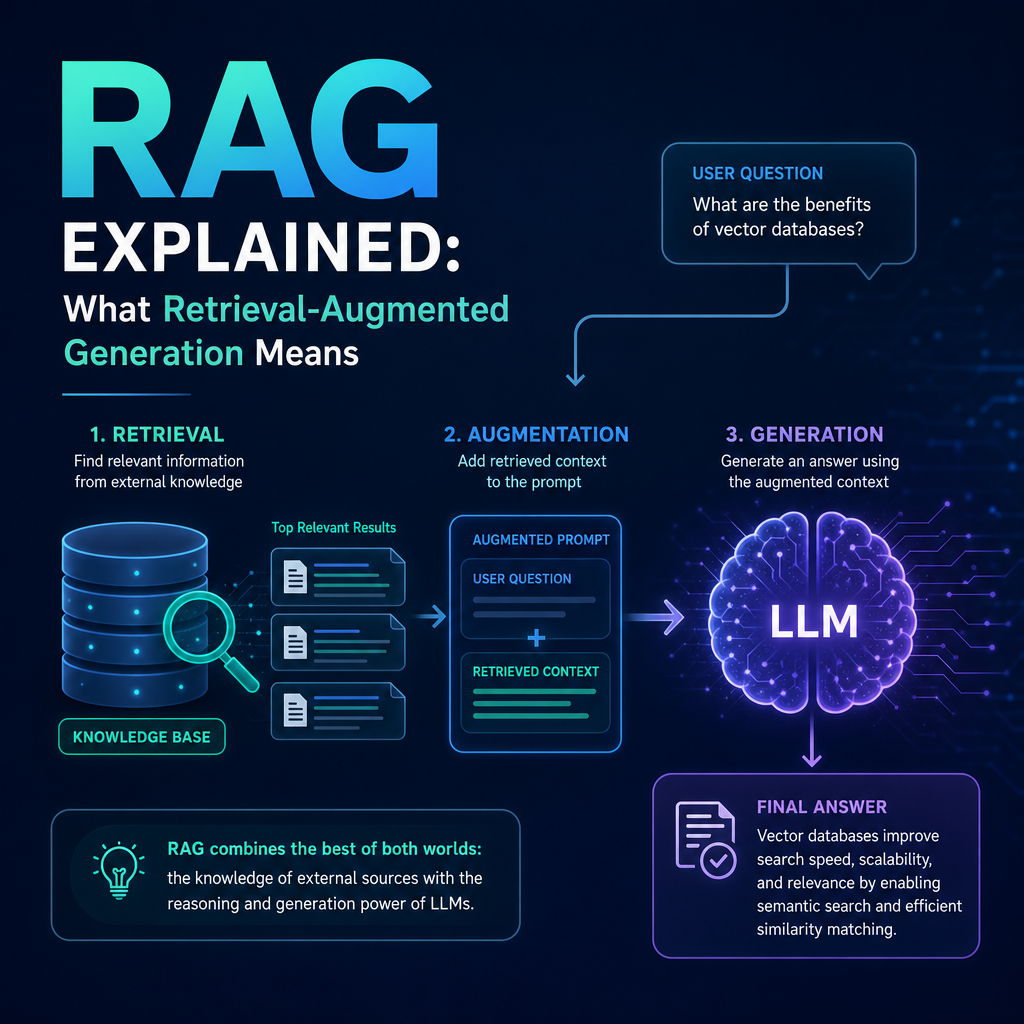
RAG Explained: What Retrieval-Augmented Generation Means
Large language models such as ChatGPT are impressive because they can generate human-like responses to a wide variety of questions. However, they have an important limitation: they primarily rely on information learned during training. As a result, they may not know about recent events, organization-specific knowledge, or documents that were never part of their training data.
Retrieval-Augmented Generation (RAG) is a technique designed to address this limitation. Instead of relying solely on the model’s internal knowledge, RAG allows the AI system to first retrieve relevant information from external sources and then use that information when generating a response.
In simple terms, RAG gives an AI system access to reference materials before it answers a question. Rather than answering from memory alone, the model can consult relevant documents and use them as context.
This idea has become one of the most important developments in modern AI systems and is widely used in enterprise assistants, customer support tools, research systems, and knowledge management platforms.
The following video provides a beginner-friendly description of how RAGs work.
The Basic Idea Behind RAG
The term Retrieval-Augmented Generation describes two separate steps that work together.
Retrieval: The system searches a collection of documents, databases, websites, or other information sources to find content related to the user’s question.
Generation: The language model uses the retrieved information to generate a response.
Without retrieval, a model may rely entirely on patterns learned during training. This can lead to outdated information, incomplete answers, or even hallucinations. By providing relevant source material, RAG helps ground the model’s response in actual information.
The external knowledge source might include:
- Company knowledge bases
- Product documentation
- Research papers
- PDFs and reports
- Internal documents
- Website content
- Help center articles
- Databases
Because the model can access information beyond its training data, RAG often produces responses that are more accurate and relevant.
How RAG Works
Although modern RAG systems can be sophisticated, the overall workflow is fairly straightforward.
Step 1: A User Asks a Question
Suppose a user asks:
“What is our company’s refund policy for annual subscriptions?”
The language model alone may not know the answer because the policy is specific to that organization.
Step 2: Relevant Information Is Retrieved
The system searches its connected knowledge sources and identifies documents that are related to the question.
Many RAG systems use vector databases and semantic search techniques. Instead of looking only for exact keyword matches, the system attempts to find content that is similar in meaning to the user’s question.
This allows the system to retrieve useful information even when the wording differs from the original documents.
Step 3: The Retrieved Content Is Added as Context
The most relevant passages are inserted into the prompt that is sent to the language model.
At this point, the model has access to both:
- The user’s question
- Supporting information retrieved from external sources
Step 4: The Model Generates a Response
The language model then produces an answer using the retrieved content as reference material.
Because the model now has access to relevant documents, the response is typically more accurate and more closely aligned with the available information.
Why RAG Is Important
RAG has become popular because it addresses several practical limitations of standalone language models.
Improved Accuracy
A language model without access to supporting information may sometimes generate incorrect or incomplete answers. By retrieving relevant documents first, RAG can reduce the likelihood of these errors.
Access to Current Information
Traditional language models are limited by the information available during training. RAG allows organizations to connect current documents and continuously updated knowledge sources.
As documents change, the AI system can immediately use the updated information without retraining the model.
Better Control
Organizations can decide exactly which information sources are available to the AI system. This provides greater control over the content used to generate responses.
Reduced Need for Frequent Fine-Tuning
If knowledge changes frequently, it is often easier to update documents than to retrain a model.
In many situations, RAG provides a practical way to keep information current without the cost and complexity of repeated fine-tuning.
RAG vs. Fine-Tuning
RAG and fine-tuning are often discussed together, but they solve different problems.
RAG focuses on providing knowledge. It retrieves information from external sources at the time a question is asked.
Fine-tuning focuses on modifying the behavior of the model through additional training. It can help a model learn a particular writing style, response format, or specialized task.
A useful way to think about it is:
- RAG provides the information.
- Fine-tuning shapes how the model responds.
Many production AI systems combine both approaches. The model may be fine-tuned for a specific task while also using RAG to access current and relevant information.
Common Applications of RAG
RAG is now used across a wide range of applications.
Customer Support
Support assistants can retrieve information from documentation, troubleshooting guides, and policy documents to answer customer questions more accurately.
Internal Knowledge Assistants
Employees can ask questions about company procedures, HR policies, technical documentation, or project information without having to manually search through numerous files.
Enterprise Search
Instead of simply returning documents, a RAG system can retrieve relevant information and generate a concise summary that directly answers the user’s question.
Research and Analysis
Researchers can interact with large collections of reports, papers, and technical documents using natural language queries.
Challenges and Limitations
Although RAG can significantly improve AI performance, it is not a perfect solution.
Retrieval Quality Is Critical
A RAG system is only as good as the information it retrieves. If irrelevant or low-quality documents are selected, the generated response may still be incorrect.
Context Window Limitations
Language models can process only a limited amount of text at one time. Including too much irrelevant content may reduce answer quality.
Source Quality Matters
RAG helps ground responses in source material, but it cannot automatically determine whether that source material is correct. If the retrieved documents contain errors or outdated information, those issues may appear in the final response.
Evaluation Remains Challenging
Evaluating a RAG system involves more than checking whether the generated text sounds good. Developers must assess retrieval accuracy, factual correctness, and the usefulness of the final answer.
Best Practices for Building RAG Systems
Several practices can improve the performance of a RAG pipeline:
- Keep source documents accurate and up to date
- Divide large documents into meaningful chunks
- Use metadata to improve filtering and retrieval
- Regularly evaluate retrieval quality
- Instruct the model to rely on retrieved content
- Provide citations or references when possible
Small improvements in document preparation and retrieval often produce larger gains than changing the underlying language model.
Final Thoughts
Retrieval-Augmented Generation has become one of the foundational techniques in modern AI. By connecting language models to external knowledge sources, RAG helps reduce hallucinations, improve accuracy, and provide access to information that may not exist in the model’s training data.
As organizations continue to deploy AI systems in real-world settings, the ability to combine powerful language models with reliable information sources will become increasingly important. While RAG is not a complete solution to every AI challenge, it represents a major step toward building AI systems that are more useful, trustworthy, and practical for everyday use.