
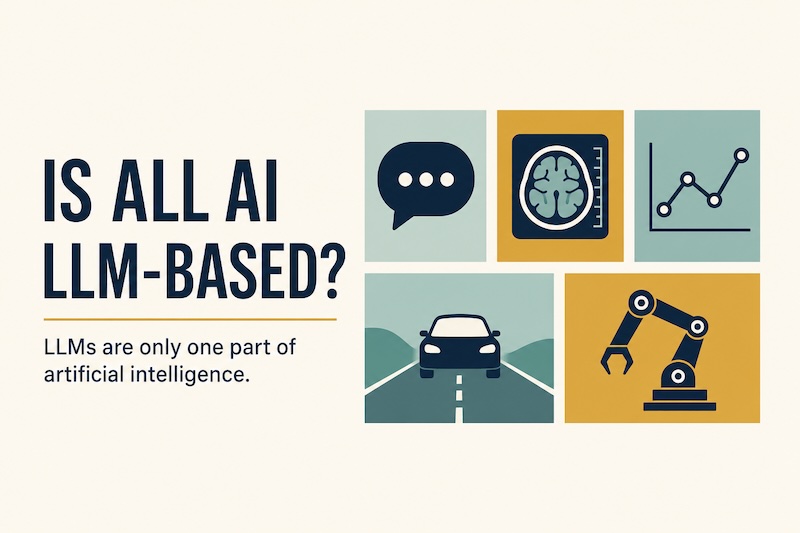
Is All AI Based on Large Language Models?
Ask someone to name an artificial intelligence system today, and they will probably mention ChatGPT, Claude, Gemini, or another conversational assistant. This is understandable. Large language models have become the most visible form of AI because they communicate in a remarkably human-like way. They answer questions, summarize documents, generate computer code, create images, and help people work through complex ideas.
Their fluency can create a misleading impression: that modern AI and large language models are essentially the same thing.
They are not.
Large language models, or LLMs, represent one important branch of artificial intelligence. Many AI systems do not use an LLM at all. Some classify medical images, detect unusual credit-card transactions, recommend movies, forecast electricity demand, guide autonomous machines, or optimize delivery routes—without generating a single word.
To understand the current AI landscape, we need to distinguish among three related but distinct concepts: artificial intelligence, machine learning, and large language models.
AI Is the Larger Field
Artificial intelligence is the broad effort to build computer systems capable of performing tasks that normally require human intelligence. These tasks may involve perception, prediction, reasoning, planning, learning, decision-making, communication, or problem-solving.
AI existed long before modern LLMs.
Early AI systems often relied on rules written by humans. A medical expert system, for example, might contain instructions such as:
If a patient has symptom A, symptom B, and test result C, consider disease D.
Such a system could make useful recommendations without learning from data. It did not understand language in the way an LLM appears to, but it still represented knowledge and applied that knowledge to reach conclusions.
Other traditional AI methods include:
- Search algorithms that examine possible actions
- Planning systems that determine a sequence of steps
- Constraint-satisfaction methods used in scheduling
- Fuzzy-logic controllers used in appliances and machinery
- Optimization algorithms used for routing and resource allocation
- Knowledge graphs that represent relationships among entities
A chess program, for instance, can examine possible moves, evaluate future board positions, and select a strategy. That is an AI task, even if the program cannot explain its choice in a conversational way.
AI, therefore, is the umbrella. LLMs occupy only one area beneath it.
Machine Learning Expanded: What AI Could Do
Traditional rule-based systems work well when experts can clearly describe the rules. But many real-world problems are too complicated for people to specify every rule.
Consider email spam detection. We could try to write rules such as:
- Flag messages containing certain phrases.
- Flag messages with too many links.
- Flag messages sent from suspicious addresses.
Spammers, however, continuously change their tactics. A fixed list of rules quickly becomes outdated.
Machine learning offers another approach. Instead of explicitly programming every condition, we provide examples of spam and legitimate email. An algorithm studies measurable patterns in those examples and learns a model that can classify new messages.
Machine learning is a major subfield of AI, but it includes many types of algorithms that are not LLMs:
- Linear and logistic regression
- Decision trees
- Random forests
- Gradient-boosted trees
- Support vector machines
- Clustering algorithms
- Bayesian models
- Neural networks
A bank might use gradient-boosted decision trees to estimate the probability that a borrower will default on a loan. A hospital might use logistic regression to estimate a patient’s risk of readmission. A manufacturer might use an isolation forest to detect unusual sensor readings from a machine.
These systems learn from data, but they are not language models. They may work entirely with numbers, categories, images, audio signals, or sensor measurements.
What Makes an LLM an LLM?
A large language model is a machine-learning model trained on an enormous amount of language-related data. During training, it learns statistical relationships among tokens—the units into which text is divided.
At its core, an LLM repeatedly performs a deceptively simple task: given the preceding tokens, estimate what token is likely to come next.
Suppose the input is:
The capital of Bangladesh is …
A well-trained model assigns a high probability to “Dhaka.” For a more complex prompt, it continues this prediction process one token at a time, producing sentences, paragraphs, computer programs, or structured responses.
Modern LLMs are commonly built on the Transformer architecture introduced in the 2017 paper “Attention Is All You Need”. The Transformer uses attention mechanisms to model relationships among elements in a sequence, including relationships between words that may be far apart. The original Transformer paper proposed an architecture based on attention rather than the recurrent and convolutional structures then dominant in sequence modeling.
The word “large” generally reflects some combination of:
- A large number of model parameters
- A large training dataset
- Substantial computing requirements
LLMs are especially capable in tasks involving language: writing, summarization, translation, question answering, information extraction, and code generation. Their abilities can extend beyond text when they are combined with components that process images, audio, video, or other data.
But language remains central to what makes them language models.
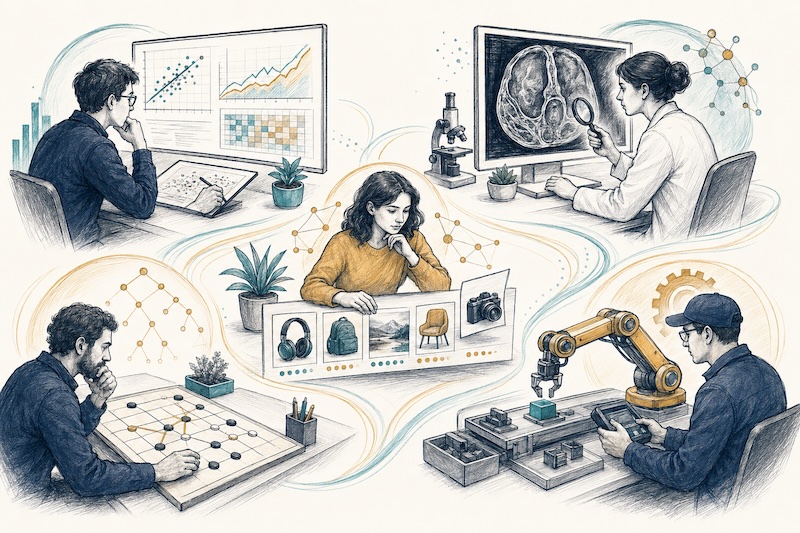
Five Common Types of AI That Do Not Require LLMs
Here are some examples of AI that do not require LLMs.
Predictive AI
Many AI applications are designed to predict a value or category from structured data.
Imagine a table in which each row represents a patient and the columns contain age, laboratory results, medications, previous diagnoses, and vital signs. A predictive model might estimate the patient’s risk of developing a particular complication.
A random forest could handle this task by constructing many decision trees and combining their predictions. As the scikit-learn documentation explains, a random forest fits multiple tree classifiers to variations of the data and averages their results to improve prediction and reduce overfitting.
No language generation is necessary. In many cases, a smaller specialized model is faster, less expensive, and easier to validate than an LLM.
Computer Vision
Computer-vision systems analyze images and video. They may identify objects, locate tumors, recognize faces, inspect manufactured parts, or estimate a person’s movement.
For years, convolutional neural networks, or CNNs, were the dominant architecture for many vision problems. The influential AlexNet (ImageNet) study trained a deep convolutional network to classify images into 1,000 categories, demonstrating the potential of deep learning for large-scale visual recognition. (The AlexNet paper.)
Transformers are now widely used in computer vision as well. However, a Transformer is not automatically an LLM. “Transformer” describes an architecture; “large language model” describes a type of model, along with its principal training objective and data.
A vision transformer trained to classify retinal images is a vision model, not necessarily a language model.
Recommendation Systems
When a streaming service suggests a movie or an online store recommends a product, it may use a recommendation system that examines user behavior, item characteristics, and patterns across similar users.
The model may ask questions such as:
- Which videos did this user watch?
- How long did the user watch them?
- Which products are frequently purchased together?
- Which items attract people with similar histories?
Recommendation systems can use matrix factorization, nearest-neighbor methods, neural networks, ranking models, or combinations of these techniques. Google researchers, for example, described YouTube recommendations as a two-stage process involving candidate generation followed by ranking. Their paper focuses on specialized deep networks rather than a conversational language model.
An LLM can enhance a recommendation system by interpreting reviews or explaining a recommendation, but it does not have to be the system’s primary prediction engine.
Reinforcement-Learning Systems
In reinforcement learning, an agent interacts with an environment. It takes actions, observes the results, receives rewards or penalties, and gradually learns a strategy that maximizes long-term reward.
This approach has been used in games, robotics, resource allocation, and control systems.
AlphaGo provides a well-known example. It combined policy networks, value networks, reinforcement learning, and tree search to select moves and evaluate board positions. It did not win by holding a conversation about Go. It won by repeatedly evaluating actions in a structured decision environment. The AlphaGo research illustrates how several AI techniques can work together within a single system.
Today, an LLM can be incorporated into an agent, particularly when the agent must interpret instructions or operate through language. Nevertheless, reinforcement learning is a broader learning framework and does not inherently require an LLM.
Robotics and Control Systems
A robot may need to perceive its environment, estimate its location, plan a path, avoid obstacles, control motors, and respond to changing conditions.
These functions can involve:
- Object-detection models
- Depth estimation
- Simultaneous localization and mapping
- Motion-planning algorithms
- Feedback controllers
- Reinforcement-learning policies
- Sensor-fusion techniques
An LLM might allow a person to tell a robot, “Bring me the blue cup from the kitchen.” But the LLM alone does not determine the precise motor commands needed to grip the cup without dropping it.
Language can express the goal. Other AI and engineering components must translate that goal into reliable physical action.
Generative AI Is Also Broader Than LLMs
Another common misconception is that all generative AI is LLM-based.
Generative AI refers to systems that create new content, including text, images, audio, video, code, 3D objects, and synthetic data. LLMs are one form of generative AI, primarily associated with language and code.
Image generators have often used diffusion models. These models learn to reverse a process in which noise is gradually added to an image. During generation, the system begins with noise and progressively transforms it into a coherent image.
Other generative approaches include:
- Generative adversarial networks
- Variational autoencoders
- Autoregressive image and audio models
- Diffusion models
- Flow-based models
A text prompt may be interpreted by a language encoder or language-related component, but the part that constructs the image may use a fundamentally different generative process.
Therefore:
- Not all AI is generative AI.
- Not all generative AI is an LLM.
- Not every Transformer is an LLM.
- Not every neural network is a Transformer.
- Not every AI system even uses a neural network.
These distinctions matter because the terms describe different levels of the technology landscape.
Why Does It Seem as Though Everything Is LLM-Based?
LLMs have become an increasingly common interface to other technologies.
Suppose a company builds an assistant that answers questions about sales. Behind the interface, several different systems may be working together:
- An LLM interprets the user’s question.
- A retrieval system finds relevant documents.
- A database executes a structured query.
- A forecasting model predicts future sales.
- A program generates a chart.
- The LLM explains the results in natural language.
The user encounters one conversational assistant, so the entire application may appear to be an LLM. In reality, the LLM acts as the coordinator or communication layer. The numerical forecast may come from a time-series model, the records from a database, or the chart from conventional software.
This hybrid structure is increasingly important. LLMs are powerful partly because they can connect people to specialized tools using ordinary language.
But fluency should not be confused with universal competence. A model that can describe how forecasting works is not automatically the best model for forecasting tomorrow’s electricity demand.
When Should We Use an LLM?
An LLM is a sensible choice when the core problem involves unstructured language or benefits strongly from a natural-language interface. Examples include:
- Summarizing documents
- Drafting and revising text
- Extracting information from reports
- Answering questions over a document collection
- Translating between languages
- Generating or explaining computer code
- Interpreting loosely phrased user requests
A conventional or specialized model may be preferable when:
- The inputs are primarily structured numerical data.
- The required output is a narrow prediction.
- Decisions must be highly reproducible.
- The system must run on a small edge device.
- Inference cost and response time are critical.
- Training data is limited, but meaningful features are available.
- Regulators or domain experts require a transparent decision process.
Consider a wearable device that classifies five hand movements from accelerometer data. A compact convolutional network, random forest, or time-series model may provide excellent performance with minimal power consumption. Installing an LLM for that classification task would add complexity without necessarily adding value.
However, the completed application might still use an LLM elsewhere—for example, to convert a week of movement summaries into a readable report for a therapist.
The right question is not “Can an LLM do this?” It is: “Which model or combination of models best fits the task, data, risk, hardware, and users?”
The Future Is Likely to Be Hybrid
The future of AI is unlikely to consist of one enormous language model performing every operation by itself. More plausibly, capable systems will combine several forms of intelligence.
An LLM may interpret a goal and formulate a plan. A vision model may analyze an image. A forecasting model may estimate future demand. An optimizer may allocate resources. A rules engine may enforce safety constraints. A human may review the final decision.
This architecture resembles a team of specialists more than a single all-knowing machine.
LLMs are changing how people interact with computing. They make software more conversational, knowledge more accessible, and complex tools easier to control. Their importance is difficult to overstate.
But AI is larger than language.
Sometimes intelligence means producing a thoughtful explanation. Sometimes it means detecting a one-degree temperature change in a turbine, identifying a tiny abnormality in a medical image, choosing a safe path through a crowded room, or predicting equipment failure before it happens.
None of those systems must be able to write an essay.
The rise of LLMs has not reduced artificial intelligence to one technology. It has added a powerful new layer—one that may increasingly help us communicate with all the other forms of AI operating quietly beneath it.