
Future of Medical AI May Depend on Smaller Models, Not Bigger Ones
Artificial intelligence headlines are dominated by increasingly larger models. New models keep appearing with more parameters, larger training datasets, longer context windows, and greater computational requirements. The assumption often seems to be that bigger is always better.
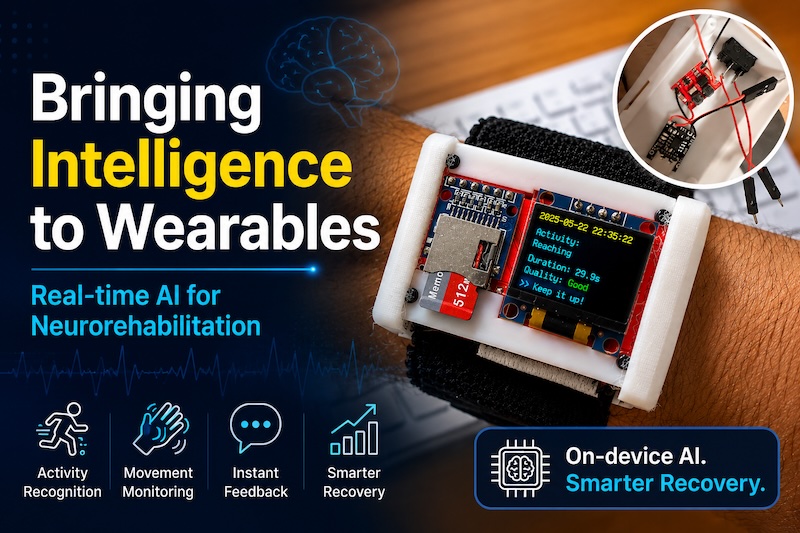
Yet in healthcare, particularly in wearable medical devices, the future may require the opposite direction. Instead of larger models running on massive GPU clusters, we may need highly specialized, energy-efficient AI models that operate directly on wearable devices no larger than a wristwatch.
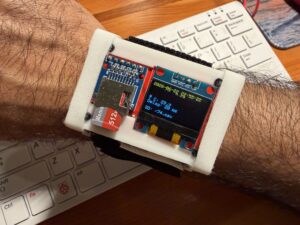
I am working on a prototype wearable device using an ESP32-C3 microcontroller, an accelerometer and gyroscope, a timer, local SD card storage, a display, and onboard power management. I wrote the software so that the ESP32-C3 continues collecting data once the device is switched on and saves it to the SD card, allowing me to analyze it later. A picture of the device in my hand is provided below.
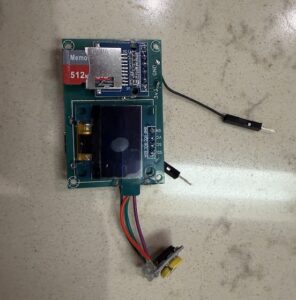
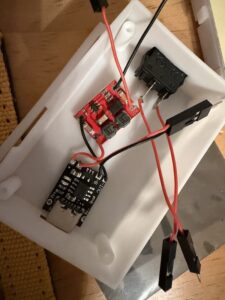
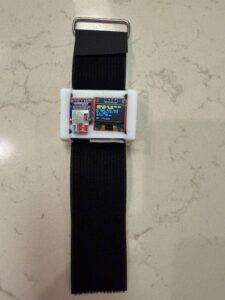
The device currently performs no AI processing on the wearable itself. It simply collects accelerometer and gyroscope data and stores it on the SD card for later analysis. This is not because the data lacks value. Rather, it reflects a fundamental limitation of today’s wearable systems. The ESP32-C3 provides excellent battery life and a compact wrist-worn form factor, but it lacks the computational resources required for most modern AI models. As a result, the device embodies a challenge faced throughout neurorehabilitation research: how can we bring meaningful intelligence directly to wearable devices rather than analyzing data after the fact?
Sensor-driven Neurorehabilitation Workflow
The majority of wearable rehabilitation systems are still designed around a “collect now, analyze later” paradigm. Patients wear sensors during therapy sessions or while performing activities of daily living. These sensors—including accelerometers, gyroscopes, smartwatches, and other motion-tracking devices—continuously record movement data. The collected data are typically stored locally or transmitted to a server for subsequent analysis.
Once data collection is complete, researchers and clinicians analyze the recordings using statistical methods, signal processing techniques, or machine learning algorithms. These analyses provide objective measures of patient performance, including arm usage after stroke, range of motion, movement frequency, functional task completion, symmetry between affected and unaffected limbs, and adherence to prescribed rehabilitation exercises. This workflow has generated valuable insights into motor recovery and has significantly advanced neurorehabilitation research.
The Challenge
Even when high-quality sensor data are available, transforming those recordings into clinically meaningful information requires substantial effort. Collecting, managing, annotating, and interpreting sensor data requires specialized equipment, computational infrastructure, and technical expertise that are not yet widely available. Consequently, most rehabilitation centers still rely primarily on therapists’ expertise and direct observation, while advanced wearable-based assessment systems remain largely confined to research laboratories and a limited number of specialized clinical centers. As a result, delivering immediate, actionable feedback to patients and therapists during rehabilitation sessions—or while patients perform exercises independently at home—remains a significant challenge.
The Missing Piece: Real-Time Intelligence
One of the most significant limitations of current wearable rehabilitation systems is the lack of real-time intelligence. Consider a stroke patient performing rehabilitation exercises at home. Modern wearable devices can collect hundreds or thousands of accelerometer and gyroscope measurements every minute, generating a detailed record of the patient’s movements throughout the day. Yet despite this abundance of data, most devices do not understand what those measurements represent while they are being collected. Instead, they function primarily as data acquisition systems, recording information for later analysis.
Imagine a different scenario in which the wearable device could recognize movement patterns in real time. Rather than simply recording sensor readings, the device could continuously interpret the patient’s actions and identify clinically meaningful behaviors. It could determine whether the patient is relying too heavily on the unaffected arm, performing an exercise incorrectly, compensating for weakness with undesirable movement patterns, or showing signs of fatigue. It could also recognize when prescribed exercises are skipped or when overall activity levels decline.
The true value of such intelligence lies not only in recognizing these situations but also in responding to them immediately. A wearable equipped with onboard AI could provide real-time guidance and encouragement during rehabilitation activities. For example, the device might suggest that the patient raise an arm slightly higher, increase the use of the affected limb during a task, slow down a movement to improve control, or take a short break when fatigue is detected. It could also provide positive reinforcement by informing patients when their movement quality or activity levels have improved compared to previous sessions.
This type of immediate feedback could fundamentally change how rehabilitation is delivered outside of clinical settings. Such a system has the potential to improve exercise adherence, increase patient motivation, encourage proper movement patterns, and ultimately enhance rehabilitation outcomes.
TinyML: Bringing Intelligence to Wearables
In neurorehabilitation research, clinicians and researchers often manually annotate activities such as reaching, grasping, lifting, eating, and grooming using video recordings and wearable sensor data. These annotations are then used to evaluate patient progress across therapy sessions. While effective, this process is labor-intensive and typically performed after data collection. A future generation of TinyML-powered wearable devices could instead recognize these activities directly from sensor data and generate meaningful summaries and feedback on the device itself.
TinyML is an emerging field that enables machine learning models to run on microcontrollers and other highly resource-constrained devices. Unlike large foundation models that require powerful GPUs, TinyML models are designed to operate with limited memory, processing power, and energy consumption, making them well-suited for battery-powered wearable devices.
TinyML has already demonstrated success in applications such as activity recognition, fall detection, gesture recognition, sleep monitoring, and cardiac monitoring. For neurorehabilitation, lightweight models running on a wrist-worn device could recognize clinically relevant movements—including reaching, grasping, tremor episodes, compensatory movements, and functional activities of daily living—in near real time rather than simply recording data for later analysis.
This capability could provide patients with immediate feedback, give clinicians richer summaries of patient performance, and reduce dependence on cloud computing. However, recognizing activities is only the first step. Clinicians also need explanations, progress summaries, comparisons across therapy sessions, and personalized recommendations. The next challenge is therefore not simply to make AI models smaller, but to make small models smarter.
Looking Ahead
For decades, wearable rehabilitation systems have primarily served as data collection tools. The next generation may become intelligent companions that observe, understand, and guide recovery in real time. Achieving that vision will require a new class of AI models small enough to run on a wrist yet intelligent enough to provide meaningful clinical insight. While much of the AI world continues to pursue larger models and larger hardware, one of the most important breakthroughs in healthcare may come from making AI smaller.