
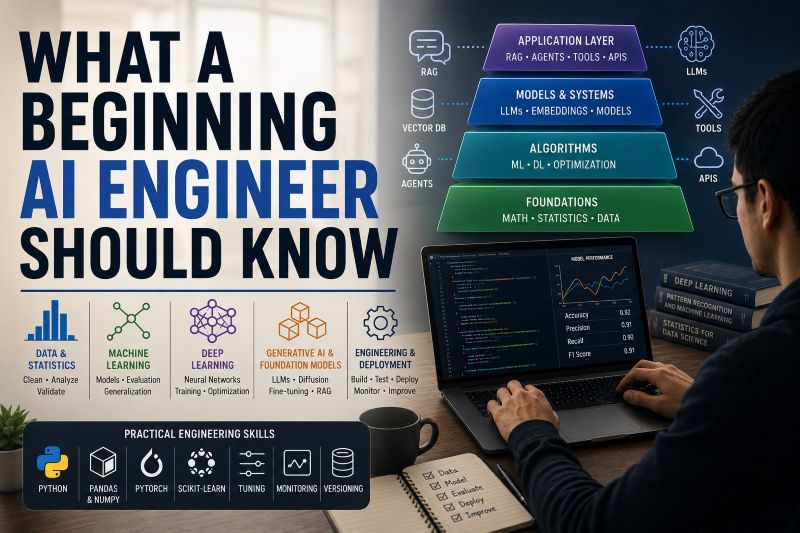
What a Beginning AI Engineer Should Know
As artificial intelligence continues to transform industries, many people are looking at AI Engineering as a career path. At the same time, there is often confusion about what an AI Engineer actually does.
Some assume that AI Engineering is primarily about connecting APIs, building chatbots, or creating applications around large language models. While those skills are certainly useful, they represent only a small part of the field.
A beginning AI Engineer should have a solid understanding of machine learning, deep learning, data analysis, and model behavior. The goal is not simply to use AI tools but to understand how AI systems work, why they work, and where their limitations lie.
In practice, AI Engineering sits at the intersection of data, algorithms, software development, and business problem-solving. An AI Engineer should be able to move from raw data to model development, evaluation, deployment, and ongoing improvement.
AI Engineering Is More Than Calling an API
Modern AI development includes tools such as large language model APIs, Retrieval-Augmented Generation (RAG), vector databases, and agent frameworks. These technologies have become important parts of many AI applications. However, these tools operate at a higher level of abstraction. They make it easier to build AI-powered products, but they do not replace the need to understand the underlying concepts.
A strong AI Engineer can quickly learn new tools because they have a solid foundation in:
- Statistics and probability
- Data analysis
- Machine learning
- Deep learning
- Mathematical optimization
- Model evaluation
- Experimental design
These fundamentals become important whenever an organization needs something beyond simple prompting. Real-world projects often require custom predictive models, recommendation systems, forecasting solutions, fine-tuned models, or domain-specific AI applications.
Understanding the foundations allows an engineer to adapt to new problems rather than relying entirely on existing tools.
Building Strong Mathematical and Data Foundations
Data is at the core of nearly every AI system. Before building sophisticated models, an AI Engineer should understand:
- Basic linear algebra
- Probability and statistics
- Fundamental calculus concepts related to optimization
- Data distributions
- Mean, variance, and expectation
- Hypothesis testing
- Data cleaning and preprocessing
- Handling missing values and outliers
- Feature scaling and normalization
- Training, validation, and testing datasets
- Data leakage
- Feature analysis and feature selection
Many AI projects fail not because of poor models, but because of poor data preparation. Understanding data is often more important than selecting a particular algorithm.
Machine Learning Fundamentals
Machine learning remains one of the most important pillars of AI Engineering. A beginning AI Engineer should be comfortable with:
- Regression and classification
- Supervised learning
- Unsupervised learning
- Self-supervised learning
- Loss functions
- Overfitting and underfitting
- Bias-variance tradeoff
- Cross-validation
- Model evaluation metrics
- Regularization techniques such as L1 and L2
- Baseline model development
- Model interpretability and model behavior
Engineers should also gain practical experience implementing models using tools such as scikit-learn rather than relying exclusively on deep learning frameworks. Understanding classical machine learning provides valuable intuition that carries into more advanced AI systems.
Neural Networks and Deep Learning
Deep learning has become the driving force behind many recent AI advances. A beginning AI Engineer should understand how neural networks work and how they are trained.
Important topics include:
- Perceptrons
- Multilayer neural networks
- Forward propagation
- Backpropagation
- Gradient descent
- Learning rates
- Batch sizes
- Activation functions such as ReLU, Sigmoid, and tanh
- Weight initialization
- Dropout
- Batch normalization
Learning how to build and train simple neural networks in PyTorch is an excellent way to develop practical intuition.
Understanding Major Deep Learning Architectures
Different AI problems require different model architectures. A beginning AI Engineer should understand the purpose and strengths of major deep learning approaches, including:
- Feedforward neural networks
- Convolutional Neural Networks (CNNs)
- Recurrent Neural Networks (RNNs)
- Long Short-Term Memory networks (LSTMs)
- Gated Recurrent Units (GRUs)
- Encoder-decoder architectures
- Attention mechanisms
- Transformers
- How embedding models work
The objective is not simply to know how to run these models but to understand why a particular architecture is appropriate for a given problem.
Generative AI and Foundation Models
Generative AI has become one of the most active areas in artificial intelligence. A beginning AI Engineer should develop a basic understanding of:
- Generative AI concepts
- Generative Adversarial Networks (GANs)
- Diffusion models
- General concept of foundation models
- BERT
- BART
- GPT-style models
- Fine-tuning
- Knowledge distillation
- Mixture-of-Experts architectures
No beginner is expected to master all of these topics immediately. However, understanding the underlying concepts provides a strong foundation for working with modern AI systems.
Practical Engineering Skills
Being proficient in theories and their applications alone is not enough. A beginning AI Engineer should also develop practical skills that help transform models into usable solutions. These include:
- Python programming
- NumPy and pandas
- scikit-learn
- PyTorch/TensorFl0w
- Hyperparameter tuning
- Error analysis
- Inference optimization
- Deployment fundamentals
- Monitoring model performance
- Detecting model drift
- Responsible design of AI systems
The ability to systematically evaluate and improve models is often more valuable than simply training a model once.
RAG and Agentic AI
Many recent discussions about AI focus on RAG systems, prompt engineering, vector databases, and AI agents. These are important technologies and are becoming increasingly common in industry.
Topics such as:
- Prompt engineering
- Retrieval-Augmented Generation (RAG)
- Vector databases
- Agentic AI
- Workflow orchestration
- API integration
are often closer to the application layer. It is important to understand that they represent only one layer of AI Engineering. It is important to understand when to use RAG and when it is appropriate to use Agentic AI.
Someone with strong foundations in machine learning and deep learning can usually learn these technologies relatively quickly. The reverse is often more difficult. Building sophisticated AI solutions requires understanding the models themselves, not just the tools that sit around them.
Final Thoughts
The strongest beginning AI Engineers are not simply users of AI tools. They understand the foundations that make those tools possible. Learning APIs, RAG frameworks, and agent systems is valuable and increasingly necessary. However, long-term success comes from understanding data, machine learning, deep learning, and model behavior. Technologies will continue to evolve. Frameworks will change. New tools will emerge. Engineers who understand the fundamentals will be able to adapt to those changes and solve problems that go far beyond connecting existing components together.