
AI Agents Explained: The Next Step Beyond Chatbots
Artificial intelligence has evolved far beyond simple chatbots that answer questions or generate text. A growing area of AI focuses on systems that can actually perform tasks, make decisions, and work toward goals with limited human involvement. These systems are commonly known as AI agents.
As organizations look for ways to automate increasingly complex workflows, AI agents are attracting significant attention. But what exactly are they, and how do they differ from the AI tools many of us already use?
What Is an AI Agent?
An AI agent is a software system designed to perceive information, make decisions, and take actions to achieve a specific objective.
Unlike traditional software that follows a fixed set of instructions, AI agents can adapt to changing situations. They analyze information, determine the next best action, execute that action, evaluate the outcome, and continue working until they reach their goal.
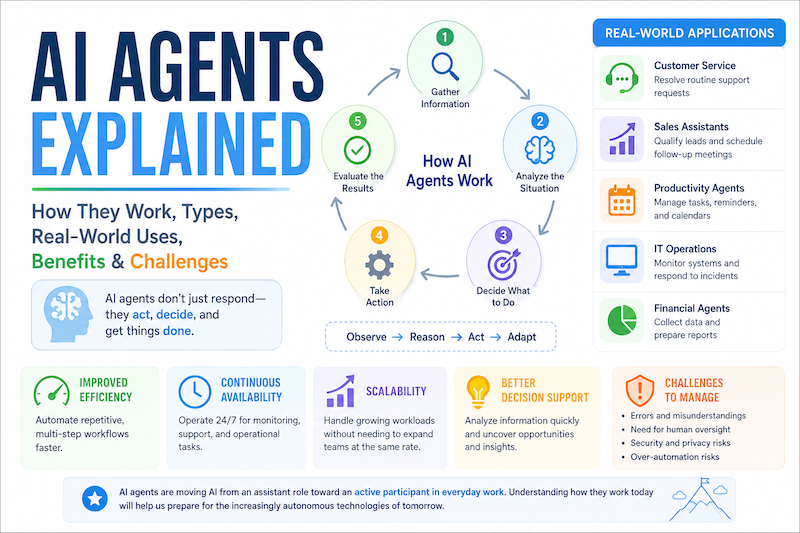
At a high level, an AI agent follows a simple cycle:
- Gather information
- Analyze the situation
- Decide what to do
- Take action
- Evaluate the results
- Repeat as needed
Because of this ability to operate through multiple decision-making steps, AI agents are particularly useful for automating complex tasks rather than simply generating responses.
How AI Agents Work
Although implementations vary, most AI agents operate through four core stages.
1. Observing the Environment
The first step is collecting information from the environment in which the agent operates. This information may come from sources such as:
- User requests
- Emails and messages
- Business applications
- Databases
- Websites
- APIs
- Sensors and connected devices
The quality of an agent’s decisions depends heavily on the quality and relevance of the information it receives.
2. Reasoning and Planning
Once information has been collected, the agent analyzes the situation and determines what actions are needed.
This may involve:
- Identifying priorities
- Breaking large tasks into smaller steps
- Comparing alternative actions
- Estimating likely outcomes
- Creating an execution plan
Modern AI agents often use large language models to assist with reasoning and planning, enabling them to handle more complex workflows than traditional automation systems.
3. Taking Action
After deciding on a course of action, the agent interacts with external systems to perform tasks.
For example, an AI agent might:
- Send emails
- Schedule meetings
- Search internal databases
- Generate reports
- Update records
- Trigger software workflows
- Retrieve information from external services
The key difference is that the agent does not simply recommend an action—it can often execute the action itself.
4. Adapting to Results
Many AI agents incorporate feedback mechanisms that allow them to adjust their behavior.
Some systems learn from historical data and user feedback, while others simply update their decisions based on new information. Either way, the goal is to improve performance and make better decisions over time.
AI Agents vs. Traditional AI Tools
One of the easiest ways to understand AI agents is to compare them with traditional AI applications. A typical AI chatbot waits for a prompt, generates a response, and then stops. An AI agent goes further by actively pursuing a goal through a series of actions.
For example:
Traditional AI Tool:
- “What meetings do I have today?”
- The system provides a list of meetings.
AI Agent:
- Reviews your calendar
- Detects scheduling conflicts
- Suggests alternatives
- Reschedules meetings
- Notifies participants
- Updates your calendar automatically
The difference is not necessarily intelligence—it is autonomy. AI agents are designed to act rather than simply respond.
Types of AI Agents
AI agents can range from simple reactive systems to sophisticated multi-agent environments.
Reactive Agents
Reactive agents respond directly to current inputs without extensive memory or long-term planning. They are fast, efficient, and suitable for straightforward tasks.
Goal-Based Agents
These agents evaluate possible actions based on whether those actions move them closer to a specific objective. They are commonly used for workflow automation and task management.
Learning Agents
Learning agents improve their performance over time by incorporating feedback, experience, or additional training data. As they gain more information, their decisions often become more effective.
Multi-Agent Systems
In some applications, multiple AI agents work together.
One agent may gather information, another may analyze data, and a third may execute tasks. By dividing responsibilities, multi-agent systems can tackle larger and more complex problems than a single agent alone.
Real-World Applications of AI Agents
AI agents are already being deployed across a wide range of industries.
Examples include:
- Customer service agents that resolve routine support requests
- Sales assistants that qualify leads and schedule follow-up meetings
- Productivity agents that manage tasks, reminders, and calendars
- IT operations agents that monitor systems and respond to incidents
- Financial agents that collect data and prepare reports
In each case, the objective is similar: reduce repetitive work, improve efficiency, and allow people to focus on higher-value activities.
Benefits of AI Agents
The growing interest in AI agents is driven by several important advantages.
Improved Efficiency
AI agents can execute repetitive, multi-step workflows significantly faster than manual processes.
Continuous Availability
Unlike human workers, AI agents can operate around the clock, making them valuable for monitoring, customer support, and operational tasks.
Scalability
As workloads increase, organizations can often deploy additional agents without needing to expand teams at the same rate.
Better Decision Support
By collecting and analyzing information quickly, AI agents can help users make more informed decisions and identify opportunities that might otherwise be overlooked.
Challenges and Limitations
Despite their potential, AI agents are not without risks.
Errors and Misunderstandings
AI systems can misinterpret instructions, misunderstand context, or make incorrect decisions when information is incomplete.
Human Oversight Remains Important
For sensitive areas such as healthcare, finance, legal services, and cybersecurity, human review remains essential. AI agents should assist decision-making rather than replace it entirely.
Security and Privacy Concerns
Because agents may access files, databases, and business systems, organizations must implement appropriate safeguards to prevent unauthorized actions or data exposure.
Over-Automation Risks
Not every task benefits from automation. Strategic decisions, ethical judgments, creativity, and relationship-building still require significant human involvement.
Why AI Agents Are Becoming Important
Recent advances in large language models, workflow automation platforms, and API integration have made AI agents far more practical than they were only a few years ago.
Businesses are increasingly looking for systems that can do more than generate content. They want AI that can complete workflows, coordinate tasks, and interact with software systems on their behalf.
This shift is moving AI from an assistant role toward an active participant in day-to-day operations.
Final Thoughts
While challenges related to accuracy, oversight, and security remain, AI agents have the potential to transform how individuals and organizations manage work. As the technology continues to mature, we can expect AI agents to become a common part of business operations, productivity tools, and everyday digital experiences. Understanding how these systems work today will help individuals and organizations prepare for the increasingly autonomous technologies of tomorrow.