
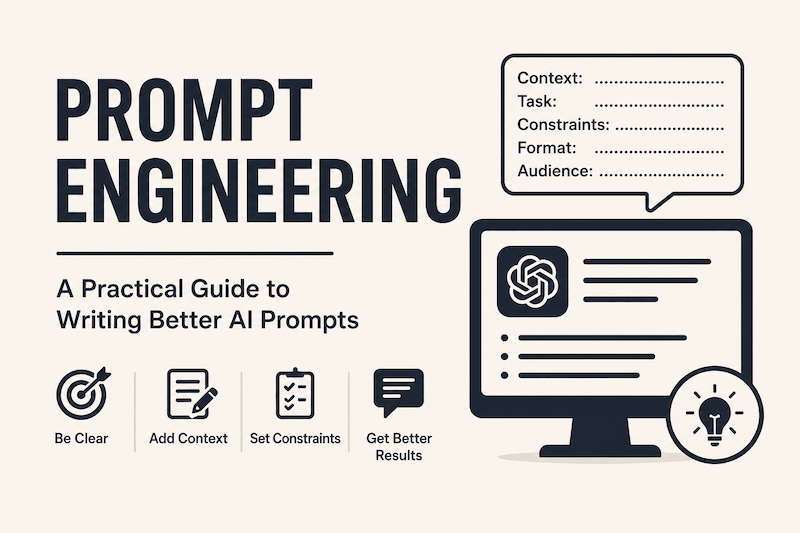
Prompt Engineering and Its Types
Artificial intelligence has dramatically changed how people write, program, analyze data, create images, and solve problems. Yet one factor consistently determines whether an AI system produces an excellent answer or a disappointing one: the quality of the prompt.
Prompt engineering is the practice of designing clear, structured, and effective instructions that guide an AI model toward producing useful, accurate, and relevant outputs. Although prompt engineering can significantly improve the quality, consistency, and usefulness of AI-generated responses, it cannot compensate for incorrect or incomplete information, guarantee factual accuracy, or replace domain expertise. Instead, prompt engineering enhances communication with AI systems, while human judgment remains essential for verifying results and making informed decisions.
Although modern AI systems have become increasingly capable of interpreting ambiguous requests, well-designed prompts continue to improve response quality, reduce misunderstandings, and minimize the need for repeated revisions.
Whether you are using ChatGPT, Claude, Gemini, Copilot, or another large language model (LLM), prompt engineering has become an essential skill for students, professionals, researchers, educators, and business leaders.
What Is Prompt Engineering?
Prompt engineering is the process of carefully crafting the input provided to an AI model in order to influence the quality, format, and usefulness of its output.
A prompt can be as simple as a single question:
Explain quantum computing.
Or it can be a detailed specification describing the audience, objectives, writing style, constraints, output format, and desired level of detail.
For example:
Explain quantum computing to first-year engineering students.
Use simple language, include one everyday analogy, avoid advanced
mathematics, and summarize the key ideas in five bullet points.
Although both prompts ask about the same topic, the second provides considerably more guidance, allowing the model to generate a response that better matches the user’s intent.
Prompt engineering is therefore less about “telling the AI what to think” and more about communicating your objective clearly.
Prompt engineering is only one component of modern AI systems. Many production applications combine prompts with retrieval, external tools, function calling, memory, databases, and software logic. Prompt engineering determines how the model is instructed, while the surrounding system determines what information and capabilities are available.
Large language models generate responses by predicting the most appropriate continuation of text based on the prompt and the knowledge learned during training. The model does not automatically know your audience, preferred writing style, or intended outcome unless you specify them.
Well-designed prompts can significantly improve:
- Accuracy
- Relevance
- Consistency
- Readability
- Formatting
- Efficiency
- User satisfaction
Poorly designed prompts often lead to:
- Generic responses
- Missing information
- Incorrect assumptions
- Inconsistent formatting
- Multiple rounds of revisions
In many practical applications, spending an extra minute writing a better prompt can save considerably more time refining the generated response.
The Building Blocks of an Effective Prompt
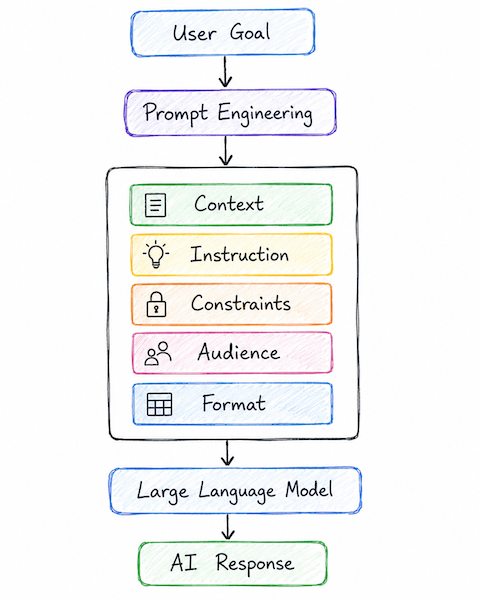
Most high-quality prompts contain several common components.
Context
Provide background information that helps the AI understand the situation.
Instead of writing:
Write about email marketing.
Provide context:
Write an introductory article about email marketing for owners
of small businesses with little technical experience.
Context tells the model who the audience is and why the content is being created.
Clear Objective
State exactly what you want the AI to accomplish.
Examples include:
- Summarize a research paper.
- Write Python code.
- Compare two programming languages.
- Explain a medical concept.
- Brainstorm marketing ideas.
- Draft a professional email.
The more specific the task, the more focused the response is likely to be.
Constraints
Constraints define the boundaries within which the model should operate.
Examples include:
- Maximum length
- Reading level
- Writing style
- Output format
- Topics to avoid
- Required sections
- Required examples
Example:
Explain reinforcement learning in fewer than 300 words using
language appropriate for high school students.
Desired Output Format
Explicitly requesting a format often produces cleaner and more usable responses.
Examples include:
- Bullet points
- Numbered steps
- Markdown
- Tables
- JSON
- HTML
- Executive summary
- Research outline
For example:
Present the comparison as a table with columns for Advantages,
Disadvantages, and Typical Applications.
Audience
Specifying the intended audience allows the AI to adjust vocabulary, depth, and complexity.
Examples:
- Elementary school students
- Undergraduate engineering students
- Software developers
- Executives
- Healthcare professionals
- Academic researchers
Examples of Prompt Engineering
The best way to understand prompt engineering is by comparing prompts of increasing quality. As additional context, constraints, and structure are added, the AI gains a clearer understanding of the user’s intent, often producing responses that are more accurate, focused, and useful. The following examples illustrate how a simple prompt can be progressively refined into a well-engineered prompt.
Basic Prompt
Explain blockchain.
This produces a general explanation but leaves many details unspecified.
Improved Prompt
Explain blockchain in simple language for high school students.
Use one real-world example and keep the explanation under 200 words.
This prompt specifies:
- Audience
- Length
- Complexity
- Need for an example
Advanced Prompt
You are writing for a technology magazine. Explain blockchain to
readers with no technical background. Use plain English, include
one analogy, provide three practical applications, and finish with
a short summary. Organize the article using Markdown headings.
This version provides substantially more guidance regarding style, structure, and intended audience.
Types of Prompt Engineering
Researchers and practitioners have developed several prompting strategies that improve AI performance across different tasks.
Instruction and Constraint Prompting
Modern large language models are primarily instruction-following systems. An instruction tells the AI what task to perform, while constraints specify how the task should be completed. Constraints may define the desired audience, length, tone, format, topics to include or avoid, or other requirements. Combining clear instructions with appropriate constraints typically produces more accurate and consistent outputs than using instructions alone.
An instruction-only prompt is provided below:
Summarize the following research article.
An example of an instruction+constraint prompt is provided below.
Summarize the following research article in fewer than 250 words.
Focus on the methodology, key findings, and limitations. Write for
undergraduate engineering students and present the summary as
bullet points.
Zero-Shot Prompting
Zero-shot prompting asks the model to perform a task without providing examples. An example of a zero-shot prompt is provided below.
Write a product description for a reusable water bottle.
Modern foundation models perform surprisingly well on many zero-shot tasks.
One-Shot Prompting
One-shot prompting is similar to few-shot prompting but provides exactly one example before asking the AI to perform the task. The example demonstrates the desired format, style, or reasoning process, allowing the model to generalize the pattern to a new input. One-shot prompting is useful when a single example is sufficient to establish the expected output without unnecessarily increasing the prompt length. It is commonly used for tasks such as text classification, information extraction, sentiment analysis, and structured content generation. An example of a one-shot prompt is provided below.
Example
Input: "The customer service was excellent."
Sentiment: Positive

Now classify:
Input: "The product arrived damaged."
One possible response from the AI is below:
Sentiment: Negative
Few-Shot Prompting
Few-shot prompting includes one or more examples before requesting new output. An example of few-shot prompting is provided below.
Example 1:
Input:
"Amazing service."
Sentiment:
Positive

Example 2:
Input:
"The delivery was late."
Sentiment:
Negative

Now classify:
Input:
"The product exceeded my expectations."
The response from the LLM should be:
Sentiment: Positive
By seeing labeled examples first, the AI can infer the desired classification pattern without requiring additional instructions. Few-shot prompting is particularly useful for tasks such as text classification, information extraction, formatting, and style imitation.
Role Prompting
Role prompting asks the AI to respond from a particular professional perspective.
Examples include:
- Act as a software architect.
- Act as a financial analyst.
- Act as a science teacher.
- Act as a technical editor.
Assigning a role conditions the model toward a particular discourse style and vocabulary. While it does not grant new knowledge, it biases the response toward the conventions associated with that profession or expertise.
Structured Prompting
Rather than asking a broad question, structured prompting organizes the request into clearly defined sections, such as objective, audience, requirements, constraints, and output format. Structured prompts are especially valuable for complex business and research tasks.
An example of such a prompt is provided below:
Task: Using the attached cybersecurity incident report, prepare
an executive summary for hospital administrators.

Objective: Provide a concise overview of the incident and its
implications.

Audience: Hospital administrators.

Requirements:
-- Describe the ransomware attack.
-- Explain its impact on hospital services.
-- Recommend three actions to improve cybersecurity.

Constraints:
-- Limit the response to 500 words.
-- Avoid technical jargon.

Output Format:
-- Organize the response using Markdown headings.
Decomposition Prompting
Decomposition prompting breaks a complex problem into a sequence of smaller, manageable subtasks. Rather than requesting a complete solution in a single step, the prompt guides the AI through a structured workflow where each stage builds upon the previous one. This approach often improves organization, reduces errors, and is particularly useful for research, software development, project planning, and analytical tasks. An example of a decomposition prompt is provided below.
First identify the main cybersecurity risks in the scenario. Next,
categorize each risk according to its severity. Finally, recommend
mitigation strategies for each identified risk.
Self-Refinement Prompting
Self-refinement prompting encourages the AI to review, critique, and improve its own previous output. Instead of accepting the first response as final, the prompt asks the model to identify weaknesses, correct errors, improve clarity, or enhance completeness. Although self-refinement does not guarantee correctness, it often produces more polished and comprehensive responses through iterative improvement. An example of a self-refinement prompt is below:
Review your previous answer. Identify any unclear explanations,
missing information, or factual inaccuracies. Then rewrite the
response to improve clarity, accuracy, and organization while
preserving the original meaning.
Retrieval-Augmented Prompting
Retrieval-augmented prompting combines prompt engineering with externally retrieved information. Instead of relying solely on the model’s internal knowledge, relevant documents, database records, or search results are provided as additional context within the prompt. This technique helps improve factual accuracy, reduces hallucinations, and allows the AI to answer questions using current or domain-specific information. Retrieval-augmented prompting forms the foundation of many Retrieval-Augmented Generation (RAG) systems used in enterprise AI applications. An example of retrieval-augmented prompting is provided below.
Using only the information provided in the attached policy document,
answer the following question. If the answer is not contained in
the document, state that the information is unavailable rather than
making assumptions.
Tool Prompting
Tool prompting instructs the AI to use one or more external tools to complete a task. Rather than relying exclusively on language generation, the model may invoke a calculator, web search engine, programming environment, database, calendar, or other specialized software to obtain information or perform computations. Tool prompting enables AI systems to accomplish tasks that would otherwise be impossible using the language model alone and is a key capability in many modern AI assistants. An example of a tool prompt is provided below.
Search the latest cybersecurity advisories for vulnerabilities
affecting Apache Tomcat. Summarize the findings and include links
to the official advisories.
Agent Prompting
Agent prompting provides high-level goals to an AI agent capable of planning, selecting tools, executing actions, evaluating intermediate results, and adapting its behavior over multiple steps. Unlike ordinary prompting, which usually asks the model to generate a single response, agent prompting is designed for systems that can pursue a broader objective through a sequence of actions. It is commonly used in autonomous or semi-autonomous AI workflows such as research assistance, software development, data analysis, scheduling, and business process automation.
An example reflecting agent prompting is provided below:
You are an AI research assistant. Survey recent publications on
federated learning in healthcare, identify major research trends,
compare competing approaches, summarize the findings in a
literature review, and recommend three promising future research
directions. Use external search tools where appropriate and verify
important claims before presenting your final report.
Iterative Prompting
Iterative prompting is the process of progressively refining prompts and responses through multiple interactions with an AI system. Rather than expecting the first response to be perfect, the user evaluates the output, identifies areas for improvement, and provides additional instructions to guide subsequent responses. Each iteration helps the AI better understand the user’s objectives, resulting in outputs that are often more accurate, complete, and better aligned with the intended purpose. Iterative prompting is particularly valuable for complex tasks such as report writing, software development, research, strategic planning, and content creation.
Example:
- Generate an outline for an article on prompt engineering.
- Expand each section into a detailed draft.
- Improve the technical accuracy and add practical examples.
- Rewrite the article for a general audience while preserving technical correctness.
- Add citations to relevant research and organize the content using Markdown headings.
Instead of viewing prompting as a single request-and-response interaction, iterative prompting treats AI as a collaborative partner that continuously improves its output in response to user feedback. This iterative workflow often produces higher-quality results than generating the final product with a single prompt.
The following table compares different types of prompting techniques.
| Technique | Best For | Requires Examples | Typical Use |
|---|---|---|---|
| Zero-shot | Simple tasks | No | General questions |
| One-shot | Pattern learning | One | Classification |
| Few-shot | Consistency | Several | Extraction |
| Role | Perspective | No | Writing |
| Structured | Complex tasks | No | Business |
| Decomposition | Complex reasoning | No | Planning |
| Agent | Multi-step workflows | No | Automation |
Evaluation of Prompt Engineering
In practice, prompt engineering is an experimental process. Different prompts should be evaluated using objective criteria such as factual accuracy, consistency, robustness across multiple inputs, execution cost, latency, and user satisfaction. This systematic evaluation helps identify prompts that perform reliably across a variety of tasks rather than only on isolated examples.
Prompt Engineering vs. Context Engineering
As AI systems become more sophisticated, many researchers and practitioners have begun discussing context engineering alongside prompt engineering. While the two concepts are closely related, they address different aspects of building effective AI applications.
Prompt engineering focuses on designing the instructions given to an AI model. It involves specifying the task, providing clear objectives, defining constraints, identifying the target audience, and describing the desired output format. The goal is to communicate the user’s intent as clearly and precisely as possible.
Context engineering, on the other hand, focuses on providing the AI model with the information and resources it needs to complete the task successfully. Rather than improving the wording of the prompt itself, context engineering determines what knowledge, tools, and state are made available to the model before or during response generation. This may include retrieving relevant documents from a knowledge base, maintaining conversation history, supplying user preferences, invoking external tools or APIs, or providing access to databases and memory.
For example, suppose a user asks an AI assistant to summarize a company’s cybersecurity policy. Prompt engineering would determine how the request is phrased—for instance, asking for an executive summary written for non-technical managers. Context engineering would ensure that the assistant has access to the latest cybersecurity policy document before generating the summary.
Modern AI systems often combine both approaches. A well-designed prompt cannot compensate for missing or outdated information, while providing extensive context cannot overcome vague or ambiguous instructions. High-quality AI applications therefore depend on both effective prompt engineering and effective context engineering working together.
In practice, prompt engineering and context engineering are complementary disciplines. Prompt engineering determines how the AI is instructed, whereas context engineering determines what information and capabilities are available to the AI. As AI assistants evolve into increasingly capable agentic systems, the ability to manage both prompts and context is becoming essential for building reliable, accurate, and trustworthy AI applications.
Common Mistakes to Avoid
Even the most advanced AI models can produce poor results when given unclear or incomplete instructions. Many disappointing AI responses can be traced back to the prompt rather than the model itself. Recognizing common prompt design mistakes can help you produce more accurate, consistent, and useful outputs.
Some of the most common mistakes include:
- Asking overly broad questions. General prompts often lead to generic answers that may not address your specific needs.
- Providing insufficient context. Without adequate background information, the AI may make incorrect assumptions about your intent, audience, or objectives.
- Combining multiple unrelated tasks into a single prompt. Asking the model to perform several complex tasks at once can result in incomplete or unfocused responses.
- Assuming the AI knows your preferences. Unless you specify your preferred tone, style, level of detail, or format, the AI must make its own assumptions.
- Not specifying the desired output format. If you need a table, bullet list, executive summary, JSON object, or Markdown document, explicitly request it.
- Ignoring constraints. Omitting details such as word limits, target audience, or required sections often produces responses that require additional editing.
- Expecting perfect results from the first prompt. Prompt engineering is an iterative process. Refining a prompt based on the initial response frequently leads to substantial improvements.
A useful way to think about prompt engineering is to imagine assigning a task to a knowledgeable colleague who has no prior knowledge of your project. The clearer, more complete, and more structured your instructions are, the more likely you are to receive the outcome you intended.
Is Prompt Engineering Still Important?
As large language models continue to improve, they have become increasingly capable of interpreting ambiguous or underspecified instructions. Compared to earlier generations of AI systems, modern foundation models often require less prompt tuning to produce useful responses for everyday tasks. This has led some to question whether prompt engineering remains an essential skill.
Current research and practical experience suggest that its role is evolving rather than disappearing. Instead of relying on carefully crafted prompts to elicit basic capabilities, prompt engineering is increasingly focused on improving reliability, reproducibility, and alignment with user objectives. Well-designed prompts reduce ambiguity, produce more consistent outputs across repeated interactions, and facilitate the integration of AI into larger workflows.
In research and enterprise settings, prompt engineering extends well beyond writing a single instruction. It encompasses the systematic design, evaluation, and refinement of prompts for complex tasks such as retrieval-augmented generation (RAG), tool use, structured data extraction, software development, scientific reasoning, and agentic AI systems. In these applications, prompt design is often combined with external knowledge retrieval, function calling, memory, and automated evaluation to create robust AI pipelines.
As AI systems continue to evolve, prompt engineering is becoming less about discovering “magic phrases” and more about designing effective human–AI communication protocols and reproducible AI workflows. For researchers, developers, and organizations adopting AI at scale, prompt engineering remains a fundamental discipline for building reliable, transparent, and high-quality AI applications.
Final Thoughts
Prompt engineering has evolved from the art of writing clever prompts into the discipline of designing reliable human–AI interactions. As AI systems become increasingly integrated into software, research, and business processes, success will depend not only on more capable models but also on our ability to communicate objectives clearly, evaluate outputs systematically, and build reproducible AI workflows. In that sense, prompt engineering is becoming a foundational skill for the age of generative AI.
This article is intended to provide a practical introduction to prompt engineering for a broad audience, including students, educators, professionals, and AI practitioners. Readers interested in a more comprehensive treatment of prompt engineering techniques, research developments, and advanced methodologies are encouraged to consult the survey paper A Systematic Survey of Prompt Engineering in Large Language Models: Techniques and Applications by Sahoo et al., which provides an extensive review of prompting methods from a research perspective.